

PROGRAMME NOTES | William Byrd (c.1540-1623) - Ave Verum Corpus
Esther Jong, 19th July, 2026
PROGRAMME NOTES
William Byrd (c.1540-1623) - Ave Verum Corpus
"Music serves not only to be performed, but to be contemplated."
Few sacred choral works embody the quiet beauty of Renaissance polyphony quite like William Byrd's Ave Verum Corpus. It remains one of the most enduring settings of the Eucharistic text from this period, conveying a musical language that is both intimate and contemplative. Throughout the motet, Byrd's musical writing remains inseparable from the sacred text, carefully shaping each phrase to illuminate the meaning and devotion of the prayer.
William Byrd composed this Ave Verum Corpus during the Elizabethan England, where he remained a practising Roman Catholic despite serving within the English royal establishment. At a time when Catholic worship was heavily restricted, many scholars believe works such as the Ave Verum Corpus were intended for the private prayers and celebration of the Mass in domestic chapels and country houses.
One particularly distinctive feature of Byrd's setting is his addition of the concluding prayer:
O dulcis, O pie, O Jesu fili Mariae, miserere mei. Amen.
O sweet, O merciful, O Jesus, Son of Mary, have mercy on me. Amen.
Byrd extends the original prayer through this additional invocation, indicating for the phrase to be repeated, allowing performers an opportunity to shape the conclusion with greater warmth, contrast and expression before arriving at the expansive final Amen. In doing so, Byrd gives particular musical weight to the closing words.
Written largely within the mode of G, the motet opens with a minor sonority before resolving to the major at the end of the opening phrase, Ave verum corpus, almost establishing the framework for the entire piece. Throughout the work, Byrd creates moments of gentle tension and release through expressive suspensions, alternating between these major and minor sonorities. Rather than relying on dramatic contrasts, the music unfolds with restraint, allowing the sacred text to remain at the centre of the listener's attention. The final Amen broadens the concluding cadence, bringing the work to a peaceful and hopeful resolution.
REFLECTIONS
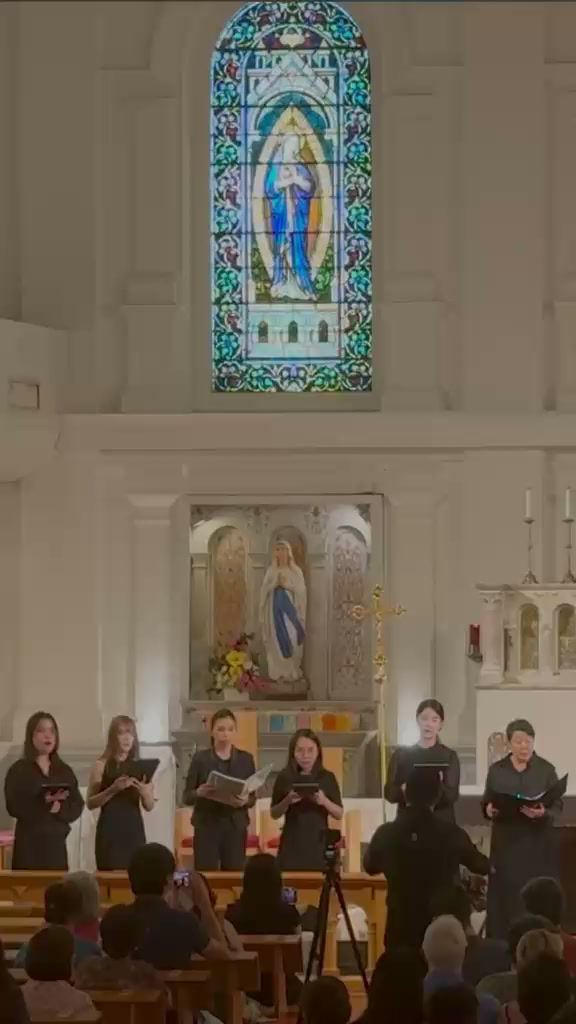
When STELLA ÆTERNA CONSORT first performed William Byrd's Ave Verum Corpus during our debut concert for the Solemnity of All Saints on 1 November 2025, our attention was understandably fixed on preparing the music itself. As a newly established ensemble, we were still discovering our own identity and artistic philosophy. Rather than searching for an elaborate interpretation, we returned to what felt most fundamental: respecting the music for what it was written to be.
That meant approaching the work with restraint. Allowing the text to speak naturally, avoiding unnecessary exaggeration, allowing ebbs and flows of the human voice to occur organically. Our rehearsals often returned to small details, not in pursuit of perfection, but in search of sincerity. The opening chords of each key phrases, the subtle interplay between the voices, and especially Byrd's distinctive final prayer, which became moments we revisited repeatedly. Even where Byrd leaves much unsaid in the score, there is remarkable freedom for performers to shape colour, breath and dynamic in respect to the sacred text.
Looking back, the Church of the Sacred Heart proved an ideal setting for that first performance. Its intimate scale suited the character of the work. Whether or not the historical circumstances can ever be fully recreated, it was difficult not to imagine Byrd's music belonging in similarly modest chapels and private households, whereby English Catholics quietly preserved their faith through prayer during a turbulent period of history.
Nearly a year later, returning to the Ave Verum Corpus whilst writing these Programme Notes has become an entirely different experience.
Ironically, our debut concert was themed around remembrance. Much of the programme naturally centred on music associated with All Saints' Day and prayers for the departed: the Introit chant of Requiem aeternam, Lassus's Justorum Animae, alongside other contemplative works. Within that programme, Byrd's Ave Verum Corpus was paired with Mozart's famous setting of the same text, offering two contrasting musical voices separated by almost two centuries.
At the time, I regarded Byrd's setting simply as one beautiful work among many within the programme. It is only afterwards, listening back to the concert recordings over time, that it quietly stayed with me.
Perhaps because there is very little in the piece that demands attention. It never seeks grandeur or spectacle. Its beauty seems to emerge through restraint rather than display.
When I think back to that evening, I find I remember less about technical execution and more about the experience itself: a small ensemble singing together within a historic church, voices blending beneath the sanctuary, the architecture, altar and music complementing one another. None of those individual elements were extraordinary on their own. Yet together they created something greater than the sum of their parts.
It reminded me that beauty is often cumulative. It emerges when many small acts of care quietly support one another.
Revisiting the piece again this year has also reminded me that music rarely remains the same after we have lived with it for a while. Although I had sung Ave Verum Corpus many times throughout my sacred music journey, performing it in 2025 with SAEC, and now reflecting on it again in 2026, has revealed details that I simply hadn't noticed before. Not necessarily new musical techniques, but different emotional and spiritual resonances. Perhaps the piece itself has not changed at all. Perhaps it is only I who have changed.
That thought has become one of the unexpected gifts of revisiting these Programme Notes with the intention of creating a reflective series on this online journal.
Writing about sacred music encourages a slower kind of listening. Performance is only one way of encountering these works. Studying them, reflecting upon them, understanding their historical context, and returning to them over time are equally valuable forms of engagement. Each revisit seems to illuminate another small detail that previously passed unnoticed.
PERFORMANCE
Performed by STELLA ÆTERNA CONSORT
Debut Concert for the Solemnity of All Saints
Church of the Sacred Heart, Singapore
1 November 2025