

The Season of Easter, the Paschal Mysteries and its Significance for Christians around the world
Esther Jong, 10th May, 2026
INTRODUCTION
The profound mystery and significance of Easter stand at the very heart of the Christian faith. Easter is the culmination of the sacred narrative that “begins” with Christmas, the celebration of the birth of Christ. Others believe that the Easter season begins with the Annunciation, the moment that the Virgin Mary said “yes” to a visiting angel, and allowed herself to miraculously conceive of a child through the Holy Spirit, and maintain her purity. Yet within Christian theology, the significance of Easter is understood to extend far beyond the events of the New Testament alone. Many theologians have long held that the mystery of Christ was foreshadowed from the very beginning of creation (if not before). For example, in the writings of St. Augustine, the fall of Adam and Eve is seen not only as the origin of sin, but as the moment that revealed humanity’s need for redemption through a saviour. St. Augustine’s writings is mirrored in the felix culpa (“happy fault”), later developed in the writings of St. Thomas Aquinas, which suggests that the fall itself set the stage for a greater good – one way to keep optimistic!
From Christ’s miraculous conception and birth through the Virgin Mary, He entered the world as both fully human and fully divine, embodying God’s promise of salvation. The wage of sin is death, is a statement that suggests that for every 'sin', there needs to be repayment of equal value. In ancient times, and even in other religions and cultures today, sacrifices are made in attempts to appease spiritual balance. In the form of Christ, He is the perfect sacrifice to atone for all sins of this world, as being pure, divine, holy, which paved the way for the rest of humanity to have an equal chance at salvation. In Christian teaching, it is through Christ’s Passion (i.e. His suffering, crucifixion, and death) that this Christian promise is fulfilled in its most profound form.
SPIRITUAL PREPARATION (PRAYER AND FASTING ACROSS RELIGIONS AND CULTURES)
Christians across denominations regard Easter as the central and most profound celebration of their faith. It fosters a communal experience marked by liturgy, prayer, baptisms, and for some, a point of reflective renewal of their faith. The Easter season is preceded by Lent, a penitential period of approximately forty days (excluding Sundays) that reflects upon Christ’s time of fasting in the wilderness. During Lent, many Christians choose to giving up particular pleasures like sweets or entertainment, or even abstain from certain foods such as meat. Others choose more rigorous disciplines, including intensified prayer, fasting, and almsgiving (charitable acts directed toward those in need).
Many other cultures and religions also incorporate month-long fasting as a form of preparation, usually leading up to a major religious holiday. For instance, in Islam, fasting during Ramadan (a lunar month of sunrise-to-sunset fasting) commemorates the period when the Quran was first revealed and culminates in the celebration of Eid al-Fitr. Similarly, Diwali, widely celebrated in Hindu traditions, though not typically preceded by a month-long fast, still involve periods of preparation, prayer, and purification.
From a scientific perspective, fasting has been studied for its potential health benefits. Under controlled conditions, certain forms of fasting, such as intermittent fasting, may encourage biological processes like autophagy, in which cells naturally breakdown within the body at the end of its life cycle. Studies have demonstrated that autophagy plays a role in cellular maintenance, and has been linked to metabolic health, though research is ongoing for its long-term effects in humans. As with any dietary or health-related practice, fasting should be approached thoughtfully and, where appropriate, under medical guidance.
HOLY WEEK AND THE EASTER TRIDUUM
Holy Week (the week leading up to Easter Sunday) opens with Palm Sunday, which recalls Christ’s entry into Jerusalem riding on a donkey. According to the Gospels, he is greeted by crowds who spread palm branches and acclaimed him with the words “Hosanna!”. The liturgical high point for Holy Week is the Easter Triduum (from the Latin triduum, meaning “three days”), which spans from the evening of Holy Thursday through Good Friday and into the Easter Vigil on Holy Saturday night.
Holy Thursday, also called Maundy Thursday (from mandatum, Latin for “commandment”), commemorates the Last Supper, during which Christ shares a final meal with his disciples and institutes the Eucharistic bread to be shared. It is also associated with His “new commandment” to love one another. The Gospel of John records that Christ washes the feet of his disciples, a powerful gesture of humility and service that many churches reenact, in which the priest washes the feet of selected members of the congregation (typically catechumens – those undergoing the process to be baptised). The Mass concludes in a subdued manner, whereby the consecrated host is moved to an altar of repose, symbolizing Christ entering the events leading up to his death.
Good Friday is marked by a memorial liturgy reflecting on the Passion (the narrative of Christ’s suffering and crucifixion). It is a day of fasting and abstinence in many Christian traditions, particularly within Catholic practice, where abstaining from red-meat is customary. In some Western countries, fish and chips is culturally eaten on Good Friday even amongst people who aren’t Christian at all!
The Easter Vigil, celebrated after nightfall on Holy Saturday, is among the most theologically rich liturgies of the Christian calender. It begins in darkness, symbolizing the absence of Christ, before the lighting of the Paschal candle, a symbol of the “Light of Christ”. This singular flame is then shared among the congregation, gradually illuminating the church space, and symbolising Christ's light and life being shared amongst the people. The liturgy then proceeds through a series of scriptural readings, interspersed with psalms and prayers. The return of the Gloria and the ringing of bells mark a dramatic transition from Lenten austerity to Easter joy! It is during this vigil that new members are most commonly received into the Church through the sacraments of Baptism, Confirmation, and first Holy Communion (though baptisms and these other sacraments may indeed occur at other times of the year).
PERSONAL CONVERSION EXPERIENCE
It truly is beautiful to witness and experience a Roman Catholic Easter Vigil Mass, particularly one held at a Cathedral or major appoint church of an Archdiocese. I went through a personal conversion to Catholicism in 2021 when I attended the Easter Vigil at St. Mary's Cathedral within the Archdiocese of Perth for the very first time. Being surrounded by people of diverse ethnic backgrounds, I experienced a profound sense of unity. Everyone was present in quiet anticipation for this Easter Mass, with the lighting of the Paschal candle we experienced moments of active participation, communally lighting each other’s candle. The shared struggle of trying to hold the candle throughout the readings of Mass whilst attempting to avoid hot wax dripping onto the leaflet or even on yourself!
Experiencing the church being lit up in profound wonder was indescribable by words. That moment was further elevated by the triumphant melody of the Gloria, resounding through the Cathedral space on a grand pipe organ and brought to life by the musicianship of the cantors and choristers. For me, this was not merely an aesthetic experience; it disclosed something far more profound about music’s capacity to embody narrative, to intensify the shared human experience, and to communicate in ways that music, without communal context and purposeful integration, so often cannot. This Easter experience in 2021 has since instilled in me a desire to recreate, in my own way, that little bit of magic, through musical expression that others can connect with, not necessarily only in religious settings, in hopes to positively give back meaningfully to a world that’s otherwise filled with continued suffering and conflict.
I take inspiration from my chosen Confirmation Saint, St. Thérèse of Lisieux, who is also the patron saint of the May 2026 concert’s church venue here along Kampong Bahru Road in Singapore. This saint also has a dedicated chapel at St. Mary’s Cathedral in Perth, which I often found myself lighting a vigil candle in. In St. Thérèse’s spiritual autobiography Story of a Soul, she reflects on her practice of offering even the smallest actions to God, doing each one with care, intention, and love.
I pray that, through the intercession of St. Thérèse of Lisieux, this Easter concert 2026 may offer you all a moment of rest, healing, and gentle respite from the routine of daily life.
Wishing you all a Happy Easter!
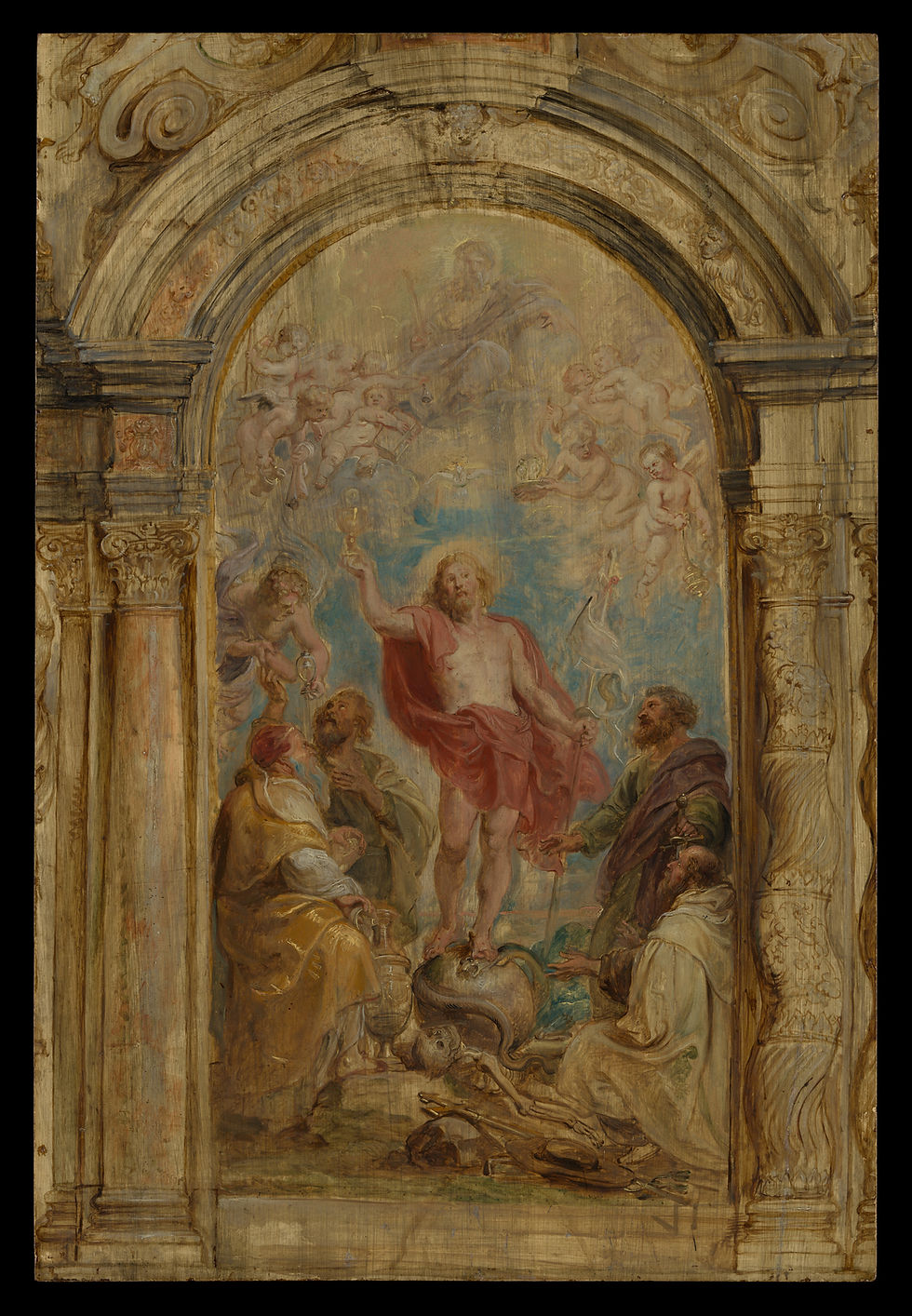
The Glorification of the Eucharist
Peter Paul Rubens Flemish ca. 1630-32
On view at The Met Fifth Avenue in Gallery 639